
A prenuptial agreement is a legal contract that outlines asset management during marriage or divorce. Not every couple needs one, but understanding who does—and why—can save thousands of dollars, years of litigation, and a great deal of stress. Here is a practical breakdown of the people and circumstances where a prenup makes the most sense.
Table of Contents
- What Is a Prenuptial Agreement (and How Does It Work)?
- Who Most Clearly Needs a Prenuptial Agreement?
- How State Laws and Community Property Rules Affect Who Needs a Prenup
- Life Situations That Strongly Suggest You Need a Prenuptial Agreement
- What Can a Prenup Cover? Property, Debts, and Spousal Support
- Making Sure Your Prenuptial Agreement Is Enforceable
- Alternatives and Complements: Postnuptial Agreements and Updates
- Practical Tips for Talking About and Negotiating a Prenup
- Key Takeaways
- FAQs: Who Needs a Prenup and How They Work
- Do We Need a Prenup if We’re Both Young and Have Almost No Assets?
- Is a Prenup Still Useful if I Live in an Equitable Distribution State Instead of a Community Property State?
- What Happens to Our Prenup if We Move to Another State After the Wedding?
- Can We Change or Cancel Our Prenuptial Agreement After We Get Married?
- Is a DIY Online Prenup Template Good Enough, or Do We Really Need Lawyers?
What Is a Prenuptial Agreement (and How Does It Work)?
A prenuptial agreement, also called a premarital agreement or prenup, is a legally binding contract signed by two people before their wedding. It governs how property, debts, and spousal support will be handled if the marriage ends through divorce or death. Prenups are signed before marriage, making them distinct from postnuptial agreements, which come after.
Prenups typically list each partner’s separate property-for example, a condo bought in 2018, retirement accounts opened in 2015, or a family business formed in 2010-and state which assets will stay separate versus become marital property or community property.
Who Most Clearly Needs a Prenuptial Agreement?

While prenuptial agreements can benefit many couples, they are particularly valuable in situations involving complex finances, prior family obligations, or significant differences in assets and liabilities. The following groups are among those who are most likely to benefit from having a prenup in place.
Couples Entering a Second Marriage
Couples entering a second marriage often use prenups to protect their children’s inheritance. If one spouse has children from a prior marriage, a prenup can designate specific assets—a house, a life insurance policy, an investment portfolio—for those family members. Individuals with children from previous relationships benefit from prenups because they reduce the risk of unintended property division outcomes.
By documenting these intentions before the marriage, couples can help minimize future disputes and ensure their estate planning goals remain aligned.
Couples With Significant Assets or Debts
Prenups are particularly beneficial for couples with significant wealth, assets, or debts. When one partner owns a $700,000 home, brokerage accounts, and a business while the other has little savings, a prenup helps avoid disputes over what counts as separate versus marital property.
Clearly identifying existing assets and liabilities before marriage also makes it easier to distinguish separate property from assets acquired together during the marriage.
Business Owners and Entrepreneurs
Entrepreneurs should consider prenups to protect business interests from division. A tech founder with stock options or a partner at a law firm can use the agreement to keep ownership and control of a company out of divorce court, including clear valuation methods and whether the non-owner future spouse shares in appreciation.
Establishing these rules in advance can help preserve business continuity while reducing the likelihood of costly litigation if the marriage ends.
Individuals Expecting an Inheritance or With Different Financial Circumstances
People expecting a sizable inheritance—say, parents planning to transfer a rental property in 2027—can keep those certain assets separate. Couples with major age gaps or very different financial habits may also use a prenup to clarify expectations around joint finances, savings, and responsibility for substantial debt.
Addressing these issues before marriage encourages transparency and allows both partners to enter the relationship with a shared understanding of their financial expectations.
How State Laws and Community Property Rules Affect Who Needs a Prenup
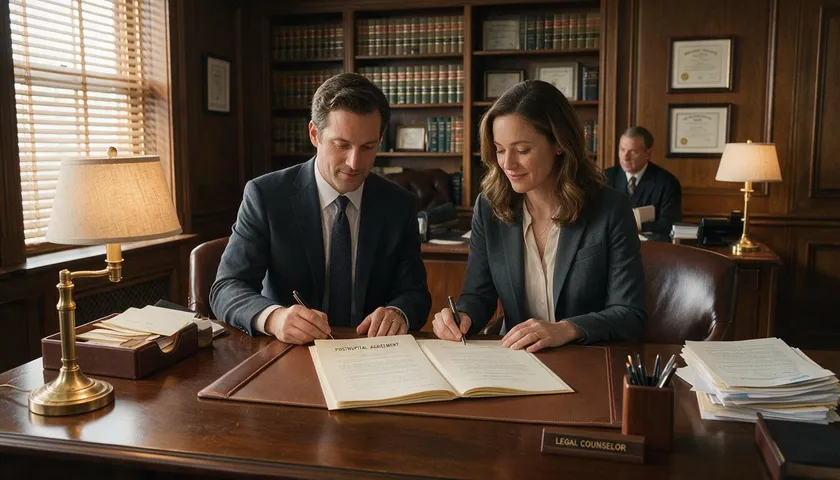
Without a prenuptial agreement, state laws automatically control property division and sometimes alimony. This default system can surprise couples who assumed their informal understanding would hold up in court.
Community Property States
In community property states such as California, Arizona, Texas, Washington, and five others, most assets and income earned during the marriage are presumed 50/50 community property. In community property states, prenups can define exceptions to shared ownership rules—keeping certain earnings or business growth separate.
For example, consider a California prenup: a software engineer in San Diego who owns pre-IPO stock options in a startup might use a prenup to classify those options and any future appreciation as separate property, overriding default California community property rules. That single clause could protect millions in future value.
Equitable Distribution States
In the other 41 states plus DC, a judge divides marital property “fairly,” which is not always equally. A court weighs factors like marriage length, earning power, and individual finances before deciding how property acquired during the marriage gets divided.
Spouses who may relocate for work or family reasons should understand that a well-drafted prenup can provide continuity even if they move from an equitable distribution state to a community property state. Some state laws restrict or scrutinize waivers of spousal support and may require extra procedural protections, such as waiting periods or proof that each party had the chance to hire their own attorney.
Life Situations That Strongly Suggest You Need a Prenuptial Agreement
Beyond wealth alone, specific life circumstances make a prenup a prudent plan. A prenup is not just for wealthy couples—it can benefit many different financial situations.
Understanding these scenarios can help couples determine whether discussing a prenuptial agreement before marriage is the right decision for their financial future.
Blended Families and Children From Previous Relationships
Blended families where one or both partners have minor children from a previous relationship often need to protect certain assets for those children. Prenuptial agreements support estate planning for children from prior relationships, ensuring property rights and inheritance rights stay clear if the parent dies or the marriage ends.
By addressing these matters in advance, couples can reduce the risk of future disputes while providing greater financial certainty for their families.
Career Sacrifices and Stay-at-Home Spouses
When one partner pauses a career to care for children or support the other’s education, a prenup can spell out spousal support or lump-sum payments that recognize the sacrifice. This protects the spouse who steps back from income-earning potential.
Including these provisions helps acknowledge the long-term financial impact of unpaid caregiving or educational support that may benefit the household as a whole.
Significant Premarital Debt
Major premarital debts—student loans incurred before 2024, credit card balances, or business obligations—can be addressed in a prenup to shield one spouse from legal responsibility for money the other borrowed.
Clearly identifying which debts remain separate can prevent confusion and reduce the likelihood of disputes if the marriage later ends.
Later-Life Marriages and Different Financial Goals
Older couples married later in life with established retirement accounts, pension benefits, and adult children often want a clear line between premarital assets and anything acquired together. Couples with very different attitudes toward investing or entrepreneurship—crypto, rental properties, speculative ventures—can use a premarital agreement to decide in advance how to handle risk, reducing uncertainty for both parties.
Discussing these issues before marriage allows both spouses to enter the relationship with a shared understanding of how major financial decisions and future assets will be handled.
What Can a Prenup Cover? Property, Debts, and Spousal Support
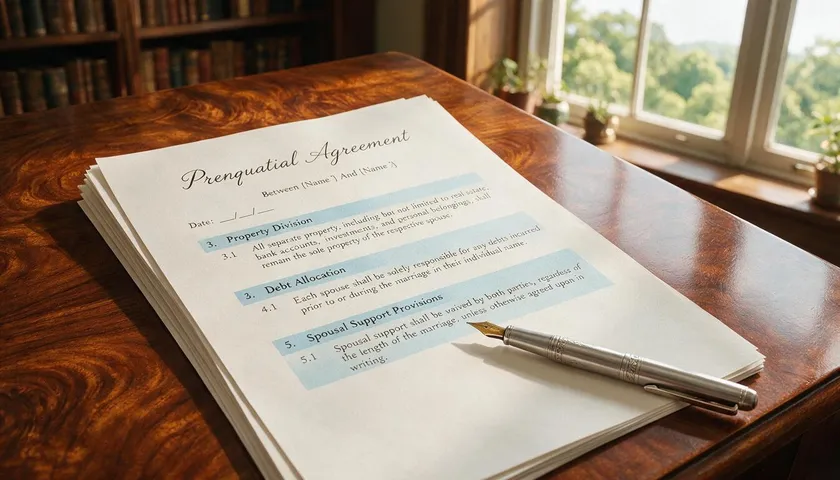
Prenuptial agreements are flexible tools. They do not need to be long; they should focus on the financial issues that actually matter to the couple.
Property (Separate vs. Marital)
A prenup can define separate property, such as savings in a 2019 brokerage account, a business started in 2020, a rental condo bought before the engagement, and marital or community property like a joint home purchased after the wedding. Prenups can protect business interests from division by specifying that ownership stays with the original owner and whether the non-owner spouse shares in any increase in value, distributions, or stock options. Prenups can also specify how retirement accounts are divided.
Debt Allocation
Debt allocation can be specified in a prenup. Typical terms assign existing student loans and credit card balances to the person who incurred them. Business debts taken out after a certain date can remain that owner’s separate responsibility unless both partners sign. This is especially relevant when one spouse carries substantial debt into the marriage.
Spousal Support
Spousal support terms can be included in a prenup. Couples can set a formula—for example, a percentage of income for each year of marriage—cap the amount or duration, or, in some states, waive alimony subject to fairness and law limits.
Common “housekeeping” provisions include who pays which household expenses, tax filing status, how to treat large gifts from parents, and whether either spouse will be reimbursed for contributions to the other’s separate property.
Prenups typically include property division terms, but certain subjects—child custody, child support, anything illegal, or clauses encouraging divorce—are not enforceable per public policy and should not be included.
Making Sure Your Prenuptial Agreement Is Enforceable
Courts take prenuptial agreements seriously but will only enforce them if they meet state law requirements. Here are the core enforceability standards presented side by side:
| Requirement | What It Means |
|---|---|
| Written and signed | The contract must be in writing, signed by both parties, and usually acknowledged before a notary public. |
| Full financial disclosure | Prenups require full financial disclosure from both parties—bank statements, credit card balances, business valuations—as of a specific date. |
| Independent legal counsel | Both partners should have independent legal counsel. Each party should consult their own attorney. In most states, this is strongly recommended; in some, it is practically required. |
| Timing | Avoid signing prenups close to the wedding date to prevent duress claims. Ideally, complete negotiations several months in advance. |
| Not unconscionable | Terms cannot be extremely one-sided. California judges won’t enforce unconscionable prenup terms. Courts may also void agreements that would leave one spouse destitute. |
Fulfilling prenup requirements makes them valid if signed under duress. The McEvoy v. McEvoy case (NY, 2023) set aside a prenup because it would have left one spouse at risk of becoming a “public charge.”
Additionally, 26 states have enacted the Uniform Premarital Agreement Act, which sets baseline procedural protections. Changes in circumstances over time can affect enforcement, so regular review or amendments help keep the agreement fair.
Alternatives and Complements: Postnuptial Agreements and Updates

A postnuptial agreement is a similar contract signed after the wedding. Both agreements clarify asset division in case of divorce, but postnups can address changes in financial circumstances after marriage, a new business started in 2026, an unexpected inheritance, or reconciliation after separation.
Postnuptial agreements may face more legal scrutiny than prenups because spouses owe each other higher fiduciary duties once married. Couples with existing prenuptial agreements should review them periodically—after the birth of children, purchase of a home, or a significant move between states.
An estate planning attorney can coordinate wills, trusts, and beneficiary designations with prenup terms so that inheritances and life insurance are distributed as intended.
Practical Tips for Talking About and Negotiating a Prenup
How a couple talks about a prenuptial agreement matters as much as the document itself. About 50% of U.S. adults are open to signing a prenup, so the conversation is far more common than many people think.
Make a detailed financial inventory together: income, recurring expenses, savings, an investment portfolio, existing support obligations like child support from a 2019 court order, and business interests. Recommend each partner consult a family law attorney who understands local state laws on spousal support, community property, and premarital agreements.
Be flexible and consider creative trade-offs during negotiations. For example, one partner keeps control of a business while the other receives stronger spousal support protections or a share of certain assets acquired after a set number of years. Keep the language clear and summarize key points in plain English so both partners fully understand the agreement.
Key Takeaways
- A prenuptial agreement is a written contract signed before marriage that sets rules for property, debts, and spousal support if the marriage ends. It is enforceable in all U.S. states when properly drafted.
- The groups who most clearly need a prenup include people with uneven wealth, prior marriages or children, business owners, those in a community property state like California, and couples with high income or debt differences.
- Without a prenup, default state laws on community property, equitable distribution, and alimony will control what happens on divorce or death—often in ways couples do not expect.
- Both partners should have their own attorney and provide full financial disclosure of all assets and debts to improve enforceability and fair outcomes.
- Postnuptial agreements can be used after the wedding if the couple decides later that they want similar protections, though courts may scrutinize them more closely.
Start your customized document in minutes: Generate prenuptial agreement online, then bring the draft to your attorney for fine-tuning.
FAQs: Who Needs a Prenup and How They Work
These frequently asked questions address practical concerns that may not have been fully covered above, focusing on real-world situations people commonly face with prenuptial agreements.
Do We Need a Prenup if We’re Both Young and Have Almost No Assets?
Couples marrying for the first time with few assets may not need a prenup. However, if either partner expects rapid income growth, plans to start a business, or wants to protect one partner from the other’s pre-existing debts, even a simple agreement can prevent future disputes.
Is a Prenup Still Useful if I Live in an Equitable Distribution State Instead of a Community Property State?
Yes. Prenups let couples define in detail what counts as separate property, how to divide marital property, and whether spousal support will be limited or waived—rather than leaving those decisions entirely to a judge’s discretion based on statutory factors.
What Happens to Our Prenup if We Move to Another State After the Wedding?
Many prenuptial agreements include a “choice of law” clause identifying which state’s laws apply. Still, have a family law attorney review the agreement after a move, especially if you relocate to or from a community property state like California, Texas, or Washington.
Can We Change or Cancel Our Prenuptial Agreement After We Get Married?
Most states allow spouses to amend or revoke a prenup in writing after marriage, often using a postnuptial agreement. Both parties must consent, and the same formalities and fairness standards apply as when the original prenup was signed.
Is a DIY Online Prenup Template Good Enough, or Do We Really Need Lawyers?
While do-it-yourself forms can be cheap, they often fail to meet specific state law requirements, ignore unique business or inheritance issues, and may be harder to enforce. Having each partner work with their own attorney—independent counsel focused on family law—greatly improves the chances that a court will uphold the agreement years later.