Figuring out how to bring up a prenup ranks among the most nerve-wracking conversations in any relationship. The good news: with the right timing, framing, and honest communication, this discussion can actually strengthen your partnership rather than threaten it.
Table of Contents
- Why the Prenup Conversation Matters More Than the Document
- When to Bring Up a Prenup?
- How to Start the Prenup Conversation (Exact Phrases to Use)
- Framing a Prenup as Teamwork and Shared Financial Goals
- Handling Your Partner’s Concerns and Emotional Reactions
- Explaining What a Prenup Actually Does (and What It Can’t Do)
- Making the Process Collaborative: From First Talk to Draft Agreement
- Why Independent Legal Advice Matters (and How to Talk About It)
- What to Do If Your Partner Says “No” (Or “Not Yet”)
- Key Takeaways
- FAQ: Bringing Up a Prenup
- How Early Is “Too Early” to Bring Up a Prenup?
- Should I Tell My Partner’s Family I’m Asking for a Prenup?
- What if I Already Proposed and the Wedding is in 3 Months?
- Can We Change Our Prenup Later if Our Situation Changes?
- Do We Still Need a Prenup if We Don’t Own Much Yet?
- How Do I Know If I Need a Prenup?
- Is a Prenup Bad for Marriage?
Why the Prenup Conversation Matters More Than the Document
How you bring up a prenup often has a bigger impact on your relationship than the legal terms themselves. A 2026 study published in Family Relations found that among couples with strong communication and commitment, having a prenuptial agreement did not lower marital satisfaction at all.
The prenup conversation is really a test of how well you and your partner handle tough subjects together. A prenuptial agreement is about shared financial planning, risk management, and clarity. It is not “betting on divorce” or assuming the marriage will fail.
Discussing money, debt, and financial expectations early helps you get on the same page and can prevent painful surprises 5, 10, or 20 years into the marriage. Many couples find that prenups foster deeper partnership discussions than they ever expected.
Consider a couple marrying in 2026 where one partner carries $80,000 in student loans and the other owns a small family business started in 2023. Without clarity, state laws may dictate asset division, potentially treating the business’s appreciation as marital property.
With a prenup, both parties agree in advance how to handle the debt and the business interests, reducing potential conflicts down the road.
Modern prenups protect both partners, not just the higher earner. They can protect both partners from debt liabilities, clarify financial roles, and reduce future misunderstandings. Discussing a prenup fosters open communication and trust right from the start.
When to Bring Up a Prenup?
Talking about a prenup agreement with your partner at the wrong time and in the wrong moment can generate discomfort. Both aspects play a critical role.
Timing
Understanding when to bring up a prenup is just as critical as knowing what to say. Initiating a conversation about a prenuptial agreement requires care and timing.
It is recommended to raise the topic well in advance of the wedding—ideally 6 to 9 months before a planned wedding date and certainly no fewer than 3 to 6 months before the ceremony.

Proposing a prenup should not be approached as a last-minute demand. Avoid raising the subject right after a proposal, during a fight, amid holiday chaos, or in the middle of stressful wedding planning decisions. Starting the prenup conversation early provides time to process emotions and make decisions without time pressure.
Timing the prenup discussion is crucial for a calm conversation. Many states look more favorably on agreements discussed and signed well before the wedding date because there is no appearance of duress, and both parties have enough time to review terms with their own attorney.
Setting
Choose a calm, private setting for the discussion. A quiet Sunday afternoon at home while you are already discussing joint finances, housing plans, or shared assets works well.
Turn off phones and set aside adequate time—at least an hour—for an uninterrupted prenup conversation.
A private setting signals that this is a heavy conversation that deserves your full attention, not something tossed out casually at dinner with friends.
How to Start the Prenup Conversation (Exact Phrases to Use)
Knowing how to talk about a prenup means leading with your intentions before ever using the word “prenup.” A respectful discussion of a prenup involves transparency and partnership planning. Use “we” language to emphasize collaboration and mutual security.
Here are sample openers you can adapt:
- “I’ve been thinking about how we’ll handle money together, and I’d like us to consider a prenuptial agreement as part of that planning.”
- “I want us both to be protected and clear about what happens with our savings, debts, and future plans, no matter what life brings.”
- “This is a little awkward for me to bring up because I love you and I’m all in, but I also want us to be responsible together.”
- “How do I bring up a prenup without it sounding like I don’t trust you? By telling you exactly that—I trust you, and I want us to build a plan that works for both of us.”
It’s important to frame the prenup as mutual protection rather than as distrust. If you are wondering how to ask for a prenup without triggering defensiveness, focus on shared financial goals first.
Use practical scenarios to make the prenup topic relatable—mention your student loans, a family business, or plans to buy a house together before introducing the idea of a formal agreement.
Framing a Prenup as Teamwork and Shared Financial Goals

Your future spouse will likely respond better if you present the prenup as “our agreement” rather than “my protection.” Frame the prenup discussion as a team effort for mutual protection. Discuss shared financial goals to approach the conversation: buying a home, starting a business together, or planning for career breaks.
A prenup can spell out how you will treat premarital assets, future inheritances, potential business interests, and how to handle big decisions if one partner steps back from work.
Prenups can help clarify how to handle investments and expenses during marriage, and they can define financial management during marriage so both people understand their rights and obligations.
Here is a simple comparison that illustrates the benefit of planning together:
| Issue | Without a Prenup | With a Prenup |
|---|---|---|
| Premarital debt responsibility | Governed by default state law; possible disputes over shared accounts | Clear agreement on who handles which debts |
| The business started before the marriage. | May be partly treated as marital property if it grew during marriage | Explicitly defined as separate property with agreed terms for appreciation |
| Inherited property or family cabin | Risk of being treated as shared assets depending on state | Protected as separate; a prenup can protect family inheritances from division |
| Spousal support after divorce | Courts decide based on length of marriage, income, needs | Parties agree on terms in advance, within state fairness rules |
| Financial expectations during marriage | Often unspoken, it leads to misunderstandings | Both partners understand their financial roles, contributions, and financial partnership |
A prenup can clarify financial roles and protect both partners while creating a shared vision for your financial future.
Handling Your Partner’s Concerns and Emotional Reactions

Discussing prenups can trigger feelings of rejection and fear. Many couples fear prenups will ruin the romance of their relationship, and many believe prenups signal a lack of trust.
Your partner’s response might include questions like “Do you not trust me?” “Are you planning for divorce?” “Why now?” or “What does a prenup mean for me?”
Acknowledge your partner’s feelings during the prenup discussion before jumping into facts. Try language like “I can see why that would feel scary. I don’t want you to feel disposable—I want us both to feel secure.” Use “I” statements and share your personal history.
For example, coming from a divorced family or owning a family business can explain why legal clarity matters to you without sounding accusatory.
Avoiding ultimatums can promote a collaborative prenup discussion. If your partner needs space, offer to pause and revisit the prenup discussion in a day or a week.
Listening actively during prenup discussions can help address concerns more effectively than pushing for an immediate answer. The idea is not to “win” the talk; it is to reach mutual respect and understanding.
Explaining What a Prenup Actually Does (and What It Can’t Do)
Total understanding of what a prenup is and its implications is an essential part of how to bring it up. That clarity ladders into how you both approach the matter.
What a Prenup Does
A prenuptial agreement is a written contract signed before marriage that defines how finances, assets, and debts will be handled during the marriage and in the event of divorce or death.
Without one, state law writes a default contract for you—so a prenup simply lets you both customize the rules to fit your relationship.
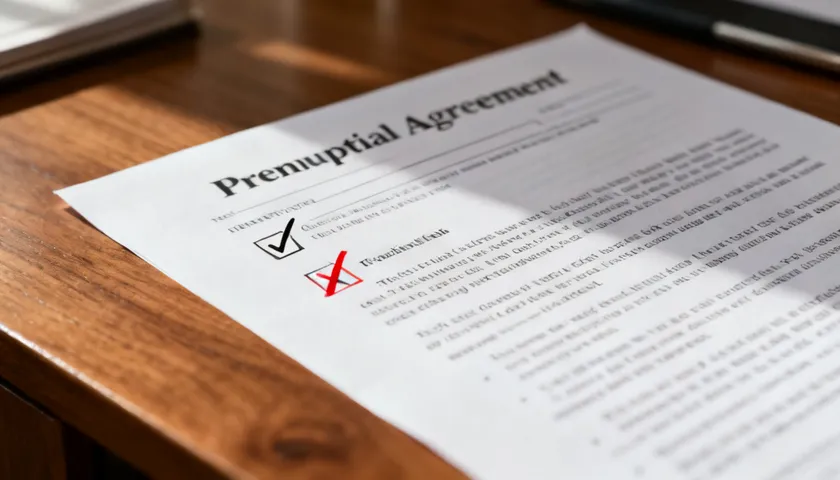
Prenups typically address property division, responsibility for debts, spousal support parameters, and treatment of future inheritances. Prenups should define premarital assets and debts to clarify financial responsibilities.
A well-crafted prenup can help each partner understand their rights and obligations. Topics in a prenup can also include protection for children from a previous marriage or a previous relationship.
What a Prenup Can’t Do
However, prenups cannot set terms for child custody or support in Washington or most other states. Washington is a community property state for asset division, and Washington courts won’t enforce prenups that are unconscionable.
Prenups must include full financial disclosure of assets and debts from both parties.
Common myths deserve correction. Prenups are not only for people with significant assets—roughly 15% of couples have them, but about 50% of U.S. adults support the idea.
A one-sided agreement that only protects the wealthier partner is more likely to be thrown out by a court. Fair prenups protect both sides, covering specific assets like intellectual property, a family business, or shared assets acquired during the marriage.
Making the Process Collaborative: From First Talk to Draft Agreement

A healthy prenup process unfolds over several conversations, not a single high-pressure meeting. Here is a step-by-step flow:
Step 1: Have the First Open Conversation
Share why the prenup matters to you and listen carefully to your partner’s concerns. Keep a positive tone and focus on your shared financial future rather than preparing for divorce. Framing the discussion as part of responsible financial planning can make the conversation feel more collaborative and less intimidating.
Step 2: Allow Time to Think
Give your partner space to reflect instead of expecting an immediate answer. Many couples revisit the subject after a few days, once emotions have settled. Allowing time for thoughtful consideration often leads to more productive and constructive conversations.
Step 3: Exchange Written Lists
Create a shared document listing what each partner wants to protect—business interests, savings, children from prior relationships, joint finances, or debt. Full financial disclosure is crucial for building trust, and a valid prenup requires both partners to disclose their assets, income, and liabilities honestly. A written list also helps identify areas of agreement before drafting the agreement.
Step 4: Align on Principles
Discuss what feels fair regarding spousal support, contributions during the marriage, and how to treat future income. Being open to compromise shows respect for your partner’s concerns. Agreeing on guiding principles first can make negotiating specific terms much easier.
Step 5: Involve Lawyers
Each of you should consult your own family law attorney to review, revise, and finalize the agreement. Independent legal advice helps ensure both partners fully understand the terms and that the agreement is more likely to withstand legal scrutiny. Discussing a prenup through separate counsel also demonstrates that each person entered into the agreement voluntarily.
Why Independent Legal Advice Matters (and How to Talk About It)

Most well-drafted prenuptial agreements involve each partner having their own family law attorney. Both parties should have independent legal representation for prenups.
Consulting independent legal counsel is advised when drafting a prenup because it protects both sides, reduces claims of coercion later, and makes the agreement more likely to hold up in court.
Suggest professional guidance without sounding threatening: “I want you to have your own attorney so you know exactly what you’re signing, and we can both feel good about it.” Financial advisors can also help you prepare documentation—bank statements, retirement accounts, and property deeds—ahead of your consultations.
Schedule consultations several months before the wedding and budget for legal fees as part of your financial planning. If you miss the window before the marriage, a postnuptial agreement is possible, but it usually feels harder emotionally than a prenup discussed before saying “I do.”
What to Do If Your Partner Says “No” (Or “Not Yet”)
Some partners will initially reject the idea, and that does not automatically mean the relationship is over. Explore what “no” really means—fear of stigma, misunderstanding of prenup terms, or worry about fairness. Ask open-ended questions rather than arguing.
Consider which points are truly non-negotiable (for example, protecting a family business) and which terms you can soften. If an agreement cannot be reached, options include postponing the wedding date, accepting the marriage without a prenup after informed discussion, or exploring a postnuptial agreement later if your financial situation changes.
The real goal is honesty and alignment. It is better to know you disagree on something this critical before the wedding than to bury the subject and let it happen without a plan. Many marriages end with unresolved money issues that an open conversation could have addressed.
Key Takeaways
- A prenuptial agreement is financial planning and protection for both partners, not a prediction of divorce or a lack of trust. The goal of the prenup conversation is to create mutual clarity.
- Choose a calm, private setting at least 6–9 months before the wedding so your future spouse never feels ambushed or under time pressure.
- Frame the discussion around shared financial goals, transparency, and teamwork. Invite your partner’s questions, edits, and concerns rather than presenting them as a demand.
- Expect an emotional response from your partner. Validate feelings, address common myths about what a prenup means, and be prepared to pause and revisit the talk.
- Involve independent family law attorneys for each partner so the final agreement is fair, enforceable, and reflects both people’s interests.
- Treat this as the start of an ongoing dialogue about money and a healthy marriage, not a one-time hurdle. The process itself can build a stronger financial partnership regardless of whether you ultimately sign.
Start your customized document in minutes: Generate prenuptial agreement online, then bring the draft to your attorney for fine-tuning.
FAQ: Bringing Up a Prenup
Below are common practical questions that were not fully covered in the sections above.
How Early Is “Too Early” to Bring Up a Prenup?
You can raise the concept once you are seriously discussing marriage, cohabitation, or joint finances—even before a formal engagement. There is no “too early” as long as the conversation happens naturally within the context of planning a life together.
Should I Tell My Partner’s Family I’m Asking for a Prenup?
The conversation should begin between you and your partner in a private setting. Outside family involvement should only happen with mutual consent to avoid added pressure or misunderstanding about your intentions.
What if I Already Proposed and the Wedding is in 3 Months?
Raise the topic immediately and be transparent about the late timing. Discuss prenups at least 3 to 6 months before the wedding whenever possible. If time is too short for a fair process, consider whether adjusting the wedding date makes sense so both parties can review terms without feeling rushed.
Can We Change Our Prenup Later if Our Situation Changes?
Yes. Many couples sign amendments or postnuptial agreements when major life events happen—new children, career changes, or large inheritances. Any changes require mutual agreement and legal review by each party’s attorney.
Do We Still Need a Prenup if We Don’t Own Much Yet?
Even couples without significant assets benefit from discussing how they will handle future earnings, debts, and potential inheritances. A prenup can define how finances grow together and protect both of you as your life evolves.
How Do I Know If I Need a Prenup?
If you have uneven assets, a prior marriage, business ownership, an income gap, or expect future inheritances, a prenup is worth considering. Even without those factors, the planning process itself helps clarify your shared financial future.
Is a Prenup Bad for Marriage?
No. Research shows that a prenup does not harm marital satisfaction when couples communicate well. The conversation itself can strengthen honest communication and financial teamwork—qualities that matter far more to a healthy marriage than any single document.